What if women are interested in sports, but not in the traditional way the media presents and markets it?
Sports have been my passion since I was young. I competed at a competitive level for years, and I’ve also been a die-hard fan at live sporting events and in front of screens so often that I consider myself a superfan. In our study, 11% of women identified themselves as such. Women’s sports have become familiar in recent years through development projects focused on women’s soccer, such as the National League strategy work. So it was super exciting to collaborate with Anu Ubaud to explore what a female sports fan is really like and what’s happening in the women’s sports market and journalism, both Finland and internationally. The project was funded by Media-alan Tutkimussäätiö.
One of the key questions of our study was if traditional sports media recognizes as a customer someone who fans in ways that differ from what they are used to.
Women’s sports and its new audience represent a massive growth market worldwide. It is known that this often younger, more digitally savvy, and more value-driven audience can't be drawn to sports content through traditional formats, service models, or channels. That’s why we also wanted to better understand, in the Finnish context, what gets women excited about sports and what kind of content resonates and keep them engaged.
Here are a few highlights:
Interest in the particular favorite sport takes over the league or logo; 72% choose the sport first. Club loyalty and today's fan culture seem foreign to many.
She picks & mixes out the most interesting events in her favorite sports. And she'd pay for individual thrilling sports moments, even if many don’t end up buying the monthly subscription package.
Social fandom is appealing, especially to younger women. The best part of sports is the intense emotions, and sharing them with good company makes them especially thrilling.
They are drawn to interesting athletes and the stories behind competitive sports. Wins and losses are the reason only for 23%. So match reports aren't enough to get women cheering.
For 21% following women’s sports is a value choice; the younger the woman, the higher the percentage. Female athletes are seen as relatable role models.
Sports need to thrive beyond traditional sports media, on platforms such as social media, where women already consume content anyway.
More sporting events where women don't feel like aliens. Yes, please.
Copy paste doesn't work. So what does?
As these highlights show, new audiences challenge to develop sports media products and service models: more diverse content angles, improved discoverability, more flexible ways to purchase, and a wider range of hooks to deepen the audience relationship.
It is important to give new audiences a meaningful role in the world of sports media. In this way, the audience evolves into a community with shared interests and rituals that feel like their own. As a result, they start building a world that is shared almost organically, even between broadcasts and seasons. We should allowr many different ways to be a sports fan: by following content on various channels, sharing it, creating it, participating in games or community events, or even through the way you dress. TogethXr, a rapidly growing media and lifestyle brand founded by soccer player Alex Morgan and her partners, is a great example of how a rich audience relationship opens up many new ways to monetize. Through content, community events, and the “Everyone Watches Women’s Sports” fashion collection created in collaboration with Nike, they’re extending their media presence from the screen deep into people’s everyday lives. It’s worth checking out, and learning from.
Women do not want a simplified version of sports designed specifically for women.
So this isn’t about trivializing sports, but rather about lowering the entry barrier and broadening perspectives. It’s true that sports journalism and content should be more accessible and available on platforms where women already feel at home. But it’s not true that they should be less expert or simplified for women.
The question is, how much growth can we afford to lose if, by repeating the old ways, we cause potential new audience, such as women, to feel that their ways of being fans are wrong?
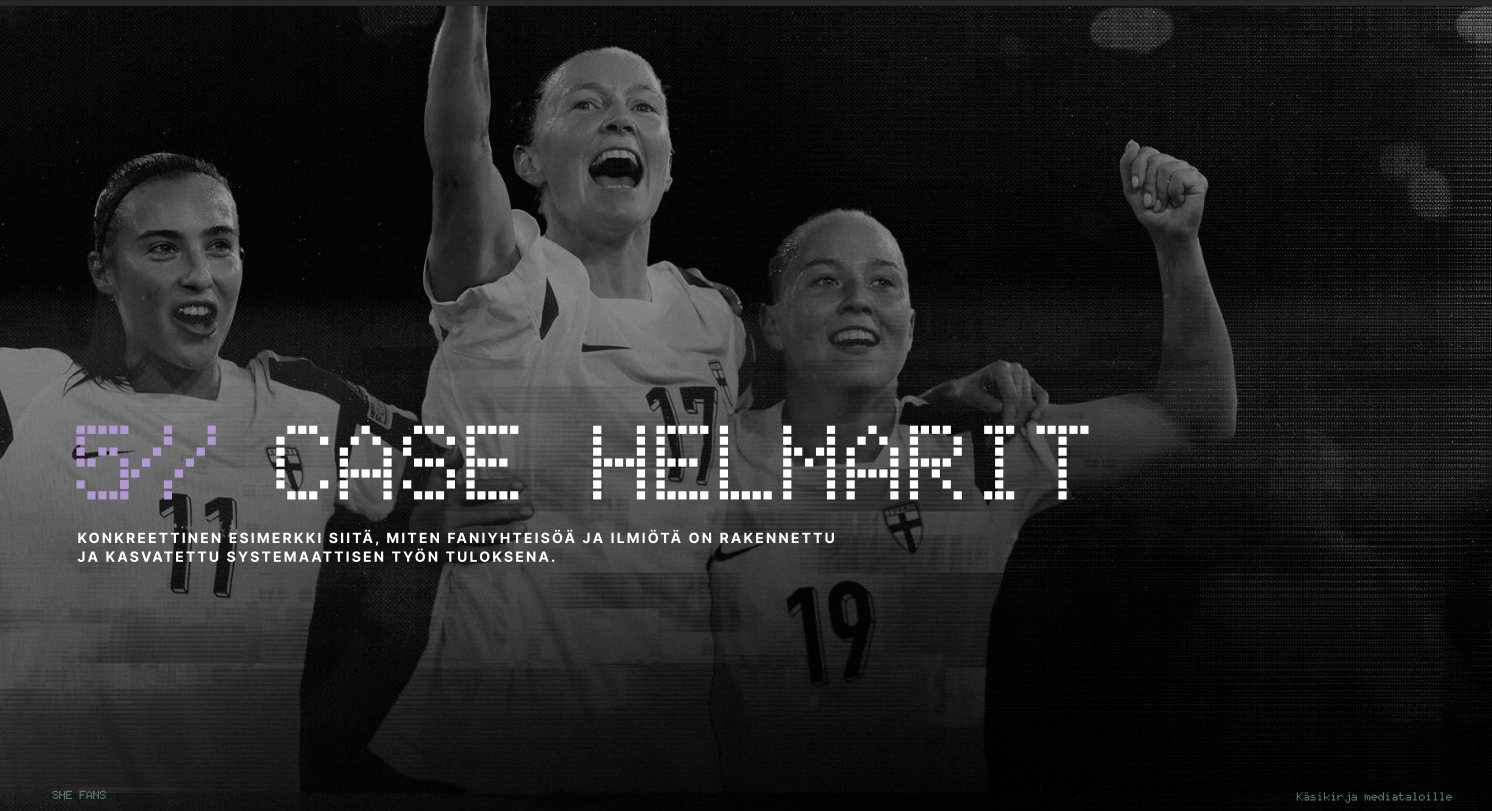
She Fans handbook here:
https://www.mediaalantutkimussaatio.fi/wp-content/uploads//She-fans_Kasikirja-mediataloille.pdf
This handbook contains only a small fraction of all the information and data we’ve collected. We’d be happy to share more, address your specific challenges and work with you to explore growth opportunities that will give new audiences room and chances to become fans.