
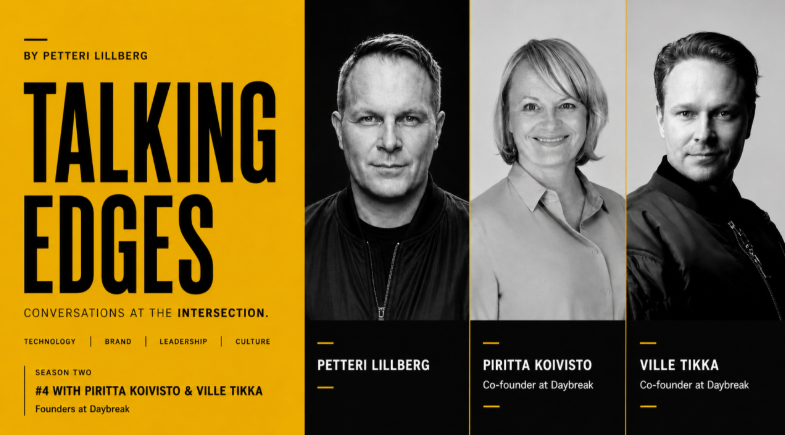
#TalkingEdges is an interview series by Petteri Lillberg that brings together leaders who are redefining the boundaries of their markets and organizations—and discovering who they truly are in the process.
This is a #TalkingEdges conversation with two people I am very lucky to call my friends, Piritta Koivisto and Ville Tikka, the founders of the brand-new strategy firm Daybreak. I’ve known Piritta for over 20 years (since our time together at Dynamo, a legendary alma mater for some of the leading figures in today’s Finnish creative scene), and Ville since the flurry of remote meetings in early 2020.
It's funny how you discover new and surprising things about people you know once you look at them through the #TalkingEdges lens. Enjoy this very inspiring conversation, our first ever with two people.
Blending Day & Night
"The day language is hard data, analytics, and business logic. The night language is the humanities, emotion, and art-based sense making. Strategy fails when we pretend they belong in separate rooms."
Ask Piritta and Ville what their competitive edge is, and you won't get a neat corporate one-liner. Well, you do get a line but one made up of many interconnected paths where logic vs. creativity and machines vs. humans lose the vs. and are replaced by and and together. Treating these as separate entities has long since ceased to produce the results modern organizations need.
Strategy isn't dead.
It's probably more needed than ever. We just need a new toolbox.
At #TalkingEdges, we’ve realized that people who do new things rarely stay within the box. They are truly unboxable. Piritta left her position as a partner at a top ad agency to co-found a customer insight firm when it was “the least media-sexy move in the business.” The agency was a success, breathing new life into a somewhat stagnant industry at the time, and provided her with an exit. Ville, in turn, has taken an unconventional leap into the cultural sector and back to explore new business models in the arts, breaking the mold of a conventional resume.
Ideas Are the Easy Part. Ruthless execution isn't.
"Coming up with ideas isn't difficult in itself, but to make them happen, you need enough structure."
In our conversation, Piritta points out that ideation is no longer a scarce resource. The real scarcity sets in after the idea. She talks about the need to execute ruthlessly and to have just the right amount of structure:
The Structure: Ruthless execution requires knowing the finer details without letting those details derail the vision.
The Human Element: A plan cannot be successfully executed without deep empathy for the people carrying it out. Authentic leadership is rooted in service.
But there's one thing to keep in mind. Ruthless execution is much more about the people than the process. As Ville puts it:
"We exist only for other people."
The Tyranny of the Business Case
The business case is the lingua franca of boardrooms. If you want to get things done, it's a format you need to master.
But our conversation raised the question of why we have come to rely so heavily on a format that often actively favors incremental thinking over breakthrough innovation.
The business case and its rigid format systematically filter out emotion, surprise, and the WOW. Daybreak’s solution is a business case designed to inspire conviction and emotion, not just defensibility. The goal isn’t to get executives to agree that the numbers add up; it’s to make someone in the room desperately the future being described.
Sustainability & The Irresistible Urge
The intersection of sustainability and business impact remains the last great hope for corporate enterprises. In our discussion, we agreed that the trap lies in the fact that responsible language falls far outside standard commercial narratives.
The key lies in total integration: framing sustainability not as a compliance issue, but as the most commercially attractive solution available. As Ville pointed out, citing the Danish Design Center, we must create “The Irresistible Urge” the undeniable emotional pull of the transition ahead.
Leading by Being Led
Very few people are born leaders; true leadership is learned from — for lack of a better word — being a follower first:
Beyond Expertise: Execution in strategy or operations gets you promoted, but leadership requires a deep, genuine interest in inspiring people.
Leading Without a Title: Finding leadership in any role by acting as a coach rather than an authority figure.
Decisiveness: While a leader may fear many things, making decisions cannot be one of them. The puck stops with you.
Equipped for the Future
Toward the end of our conversation, we turned our attention to what it means to work on the edge of an unprecedented shift. Daybreak’s mission isn’t to predict what comes next in an unstable world, but to build the capacity to navigate “not knowing.” Their closing sentiment serves as a sort of mission statement:
"We need to design an entirely new set of strategic tools for work and how we create value."
You can read the original interview here: